It has taken me a while to go through the photos from my visit to Fairburn Ings Nature Reserve on 7 June 2018. This was partly because a lot of the photos were on the limits of my camera and lens and so took a while to decide which were suitable for showing, partly because I had too many to start with and partly because I keep going out during this good weather and taking more photos.
There were several stars of the visit. One of them I did not get a photo of, and that was a Bittern flying along the edge of one of the pits and landing in the reeds. Of course it was on the far side of the pit and even though it wasn’t flying fast it was too quick for me to get even a record shot of it. Really I was too busy watching it to mess with my camera.

Another star, or stars, of the visit were the Spoonbill. It was difficult to see but this is an adult next to the nest that has, I think, two chicks in it. They are certainly not little fluffy chicks, they almost look like lazy adolescents.

The adults kept flying off to a perch nearby where they spent a bit of time preening


and some time pulling at leaves.

Above the Spoonbill nest was a Little Egret nest. You can see the two crest feathers on the left hand bird. I didn’t see much activity in or around the nest.

This is one of the adult Little Egrets with its crest feathers and yellow feet. I didn’t see it get to the nest but with the distance it doesn’t surprise me that I couldn’t see what was going on.

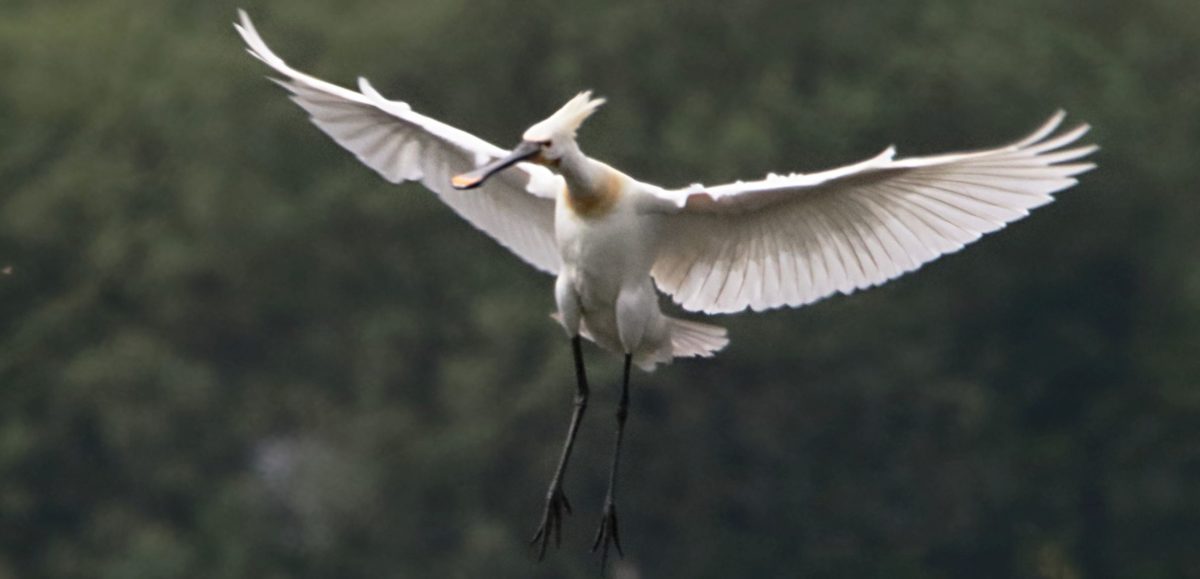
The Spoonbill nest however seemed reasonably busy. With the adults flying to and fro.

And sometimes crossing each other.


With a change in colour and a few minor changes to shape and these are Pterodactyls. I reckon Dinosaurs didn’t die out, they just grew feathers.

This is a wider view of the area but it is still a cropped photo taken at 210mm focal length. It shows a perched Spoonbill and a Grey Heron just launching into flight.

In the same cluster of trees there were several Grey Heron nests. This looks like an adult peering down at 3 expectant chicks.

An adult Spoonbill returning with food. It has some green stuff in its “beak” and some trailing green/brown stuff handing by its neck.

I’m not sure how they do it with those big beaks but this is the adult feeding one of the chicks on the nest with the vegetation it has just brought back. They are displaying quite spectacular crests.

This is an adult Cormorant, with enormous webbed feet feeding a juvenile. It looks like a dangerous business. The chick has its head in the adult’s beak and, from the bulge, looks as though it is trying to get through the back of its neck.

A couple a spindly, almost bare trees, looked like a favourite place for Cormorant nests.

Flitting around the same pond, The Moat, but a lot closer to us were a few Dragon flies including this Broad Bodied Chaser.

I later saw another on the path.

In the same pond were a few Coots and their chicks.

On the way back to the rest of the reserve there were quite a few butterflies in the meadow, like this Small Copper…

and dozens of Azure Blue Damselflies.

Walking around te Coal Pits I was pleased to see a Great Crested Grebe and a couple of chiks.

I have yet to see chicks riding properly on the backs of the Grebes but this is a shot of one of them that has just climbed aboard.

Along the areas around the Coal Pits there were quite a few Willow Warblers signing away.

In the thicker reeds I also heard Reed Warbler and I spent a bit of time keeping still and watching for the reeds moving.

I managed to get a couple of shots of one of them before the reeds closed up again.

Other stars of the visit were Black Necked Grebes.

Even with my binoculars I was struggling to confirm that they were Black Necked Grebes.

To my eye they looked very much like Little Grebes but once I had got the photos home it was obvious what they were.

Around the Coal Pits are areas of small trees that are still growing and Reed Buntings, like this one, could be heard calling.

Flitting between the reeds and the larger trees closer to the river were Linnets, like this pair.

Some of them kindly posed before flying out of range.

I took a couple of photos to show just a small part of the habitat at Fairburn Ings. There are smaller and shallower ponds and trees with other bird species – Tree Sparrow, Blue Tit, Great Tit and others. The place is well worth a visit if you are into quiet walks and wildlife or stay close to the visitor centre for plenty of birds including Kingfisher.

With that sort of habitat it is also quite easy to spot Banded Demoiselle at this time of year.
As usual the photos are on flickr and if you click on any of them it will take you to that photo on flickr in that album. Alternatively you can just go to flickr to view the photos, and others, using this link, but then you won’t have my words to read. 😉
Leave a Reply