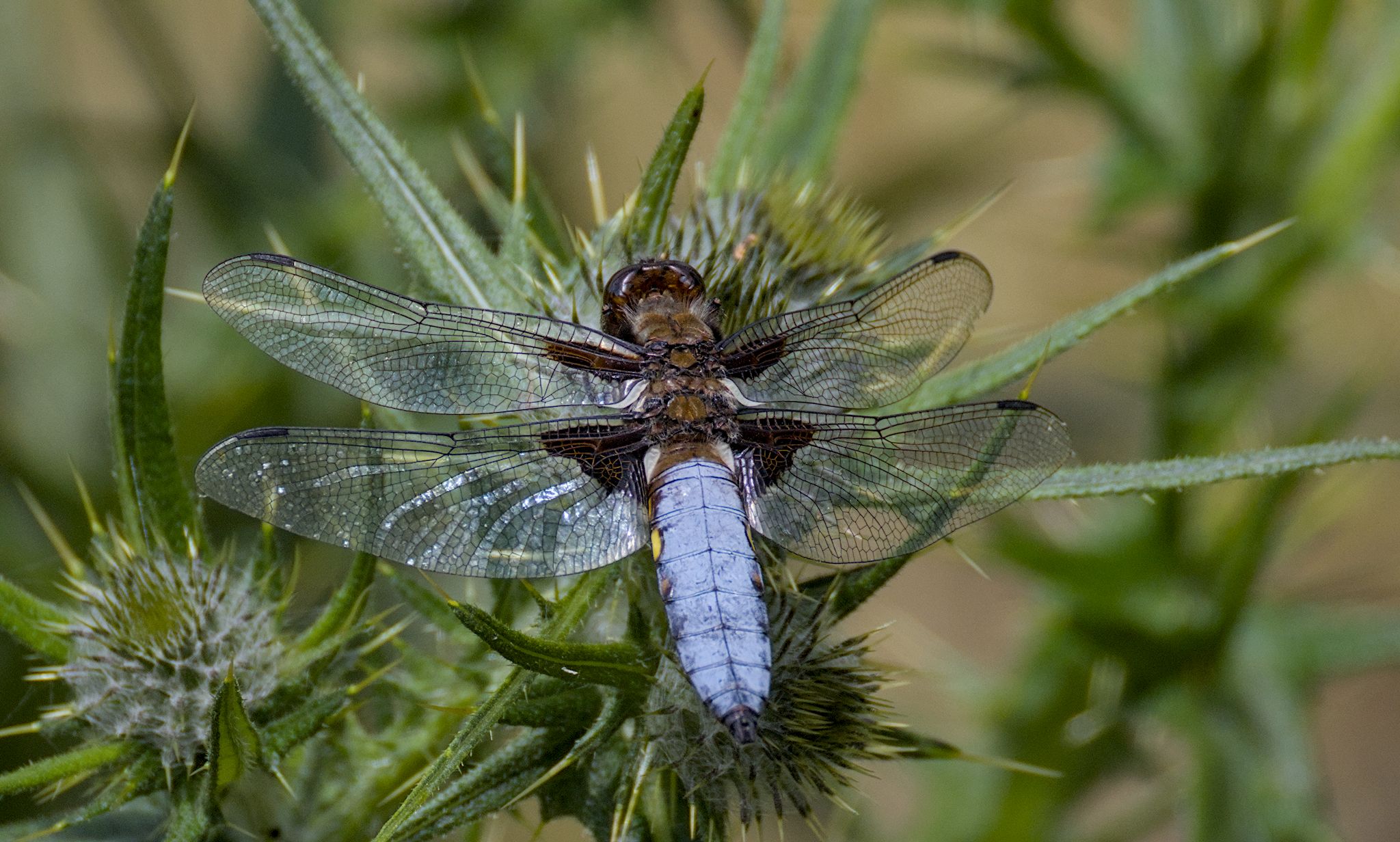
On Monday I had a walk around Gallows Hill Nature Reserve by the River Wharfe in Otley. The stars of the visit were the male and female Broad Bodied Chasers. Other things spotted were Damselflies, Ladybird in several of the stages of their life-cycle, Bumblebees and….
The Gallows Hill Nature Reserve is one of the areas looked after by Wharfedale Naturalists.
The header image is of a male Broad Bodied Chaser at one of the ponds there.
As usual you can tap/touch/click on an image to see it in better quality in the carousel gallery with an i for more information. And if you like what you see please click on one or more of the Share buttons at the bottom.
Odonata


On this pond there were up to four male Broad Bodied Chasers flying about. I assume this was a male protecting a female while she laid eggs, chasing off other males. They were just too unpredictable in their flight for me to get a photo.
The female was more predictable when she was swooping down to lay eggs.
There were many blue Damselflies around and those that settled were Azure Damselflies therefore I am making a guess that the ones in the photo of the Broad Bodied Chaser are also Azure Damselflies and not Common Blue Damselflies. The view of them in flight doesn’t show enough of to be sure.
Other Things
I kept my eyes open for the little things, partly because I knew that most of the birds I could hear would keep themselves tucked away. They are no longer sitting out in the open, singing away, to attract mates. As already mentioned tap on an image to see it in the gallery and read more about it after tapping the i.
Ladybirds
The Ladybird photos show three of the four stages of their lifecycle. The missing stage is the eggs, they will be on the underside of the leaves. I don’t fancy reaching in to turn Nettle leaves over to have a look.
The next stage is as a Larva that is a voracious predator of Aphids, leaving behind many husks of those it has eaten.
The next stage is as a Pupa, inside of which the Larva transforms into a Ladybird beetle.
The photo of the mating Ladybirds has a couple of interesting things about it. Though the Ladybirds are of the same Harlequin species they have quite different patterning on their pronotum, though you could say they both have the M or W shape of the Harlequin Ladybird, Harmonia axyridis. They are on a Nettle leaf and on the underside of the leaf are several plump Nettle Aphids. After mating the female will lay her eggs on the underside of the leaf and the Larvae will have easy access to their food. Behind the mating Ladybirds are the discarded husks of several Aphids. They could either have been shed by growing Aphids or be the remains of ones eaten by Ladybirds. On the lower leaf is what looks like small fly.


Track
The squiggles show where I wandered taking the photos. You can move around the map by dragging, you can also zoom in or out, or make the map full screen.
Please click on the images to take you to better quality images in the carousel gallery where the i will let you see the title, and caption, and some photography info.
You can also leave comments or subscribe to the site – leave your email address and you will get notified when I publish something new.
The images are published under the Creative Commons, BY-NC-SA license. Feel free to share them, edit them, but please keep my name in the credits. And if I have got the ID of anything wrong please let me know, I don’t consider myself an expert but I have write something. It is often a best guess and it would take up too much room to say It could be this, or it could be… or perhaps.


Leave a Reply