In my previous post I said that I need to check what plants are growing on Baildon Bank that might be of interest to the seed bug Horvathiolus superbus. So on Friday I went to have a look, and these are some of the photos from the 4Km walk along Baildon Bank where I found Horvath’s Knight Bug on Foxglove and rather interestingly on Heath Groundsel.
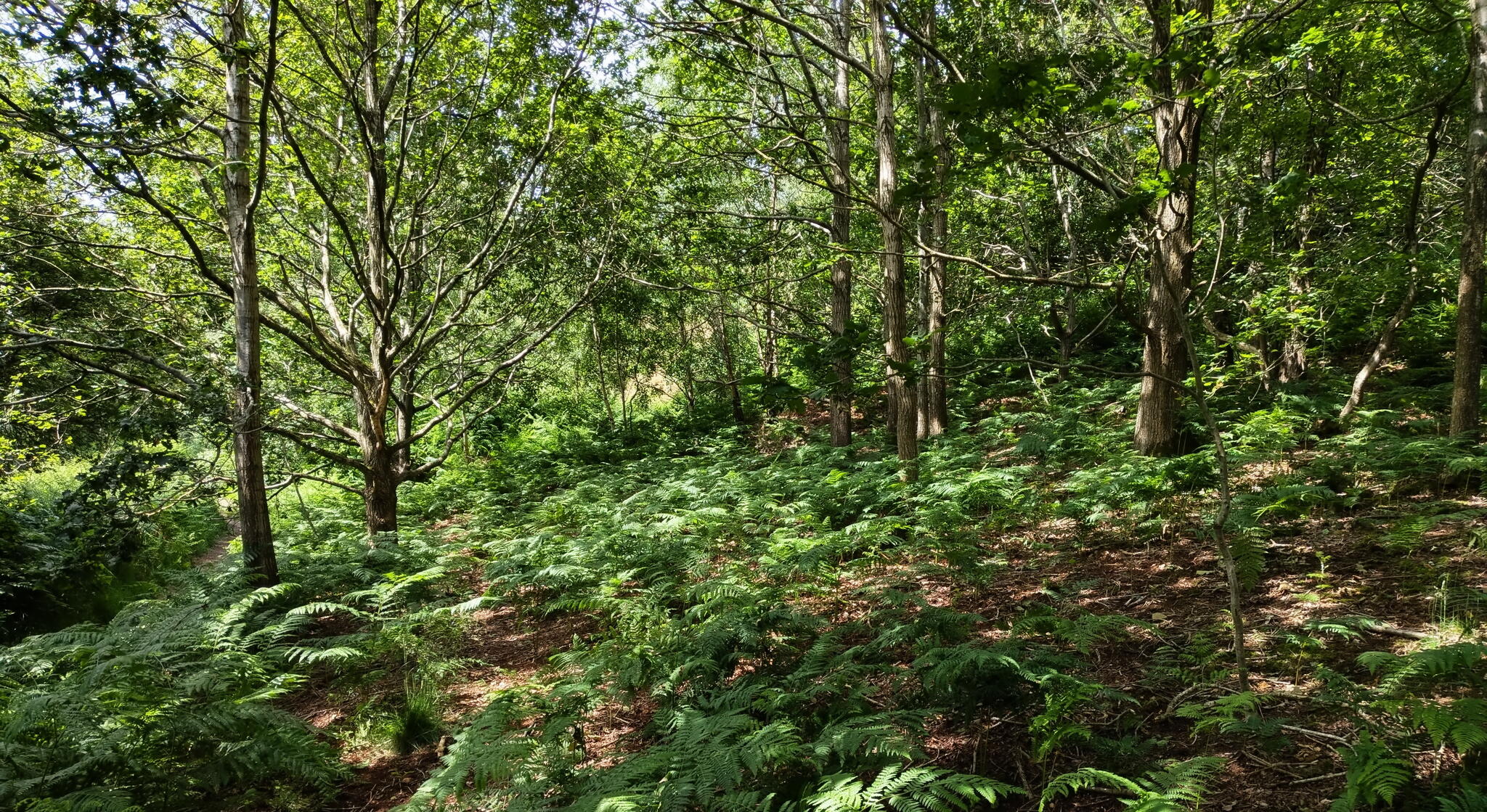
The header image is a view in Midgeley Wood, there’s more later. The view shows Sessile Oak and Silver Birch with sun and shade on the Bracken understory. I will putting these together for a post about the area to go under the Places menu option above. I am not sure where the boundaries are between Baildon Bank, Midgely Wood, and Walker Wood. Years ago there were a lot less trees along there and some of the area that is now wooded would quite definitely be regarded as Baildon Bank/Quarries. Now much of it has trees on it and would be regarded as Woods. Perhaps the variety of tree will determine the boundaries. Mmm. I’ve just thought, perhaps Midgeley Wood and Walker Wood are areas withing Baildon Bank as opposed to them being three separate areas.
As usual you can tap/touch/click on an image to see it in better quality in the carousel gallery with an i for more information. And if you like what you see please click on one or more of the Share buttons at the bottom.
Foxglove and Heath Groundsel


Armed with the knowledge that Horvathiolus superbus (Horvath’s Knight Bug) likely reached the British mainland from the Channel Islands via nursery imported Foxglove I had a general look around Baildon Bank for Foxglove. As expected, the slopes were covered in Digitalis purpurea. I had seen them many times before, but, no doubt like many others, had assumed they were just stray garden escapees. Now I was looking at them with a different focus, checking the ground for Horvathiolus superbus and then the nearby Foxgloves.
The tall spires of the common foxglove (Digitalis purpurea) were impressive, with their cascading magenta bells swarming with nectar seeking bees. A closer look revealed that many of the flower heads were heavily infested with in Aphids. The black Aphids are possibly the Black Bean Aphid – Aphis fabae, or Permanent Foxglove Aphid – Aphis armata, that will be sucking the sap from the plant. The Permanent Foxglove Aphid then injects a toxic mixture back into the plant that weakens it. The Aphids filter nutrients out of the protein poor, sugar rich, phloem sap and excrete the excess as honey dew for the Ants to collect.
Because Horvathiolus superbus is a seed eating bug I looked lower down the stalks to where the petal had dropped leaving the seeds exposed. For the first ones I looked at I didn’t expect to see any because I was a lot further East on Baildon Bank than the places I had seen Horvathiolus superbus before, but there they were, loads of them, clustered round the seeds with their needle-like mouthparts (the rostrum) drilled into the seeds
The bug’s preferred food is the Foxglove where it ingests and concentrates the plant’s deadly cardiac glycosides (heart toxins), turning their own bodies toxic to ward off predators. This chemical defence is even passed along directly to protect their eggs.
Expanding my search to some of the surrounding plants, I found several bugs on what appears to be Heath Groundsel, Senecio sylvaticus, also known as Woodland Ragwort. These plants contain a different kind of poison, volatile pyrrolizidine alkaloids, that cause liver damage to most animals, yet these seed bugs seem unfazed by that and are clustered round the flower heads. They likely still depend on a primary diet of foxgloves to successfully pass down defensive armour to their offspring, but this cross-species foraging shows them to be adaptable.
Horvath’s Knight Bug
Note that I have used the name Horvath’s Knight Bug a couple of times for Horvathiolus superbus but there is no official English common name for the bug, which has only been known on the mainland for a few years. Horvath’s Knight Bug comes from the genus name Horvathiolus, which honours the Hungarian entomologist Géza Horváth, and the Dutch common name, Kleine praalridderwants, which translates to Little Pageant Knight Bug.
Baildon Bank
These are a few photos of the woods. They show bare rocky ground in the woods with Sessile Oak and Silver Birch. Others show a Birch thicket with a sun dappled canopy. There’s impressive, large, spreading Oaks on the edge of the more open Baildon Bank. The trees have probably been coppiced many years ago causing them to branch out.
On a sunny day it is great to just stand, look, and listen. I have done that several times and seen or heard Woodpeckers, both Green and Great Spotted, Jays, Magpies, Pheasant, Treecreepers, Great Tits, Blue Tits, Blackbird, and Chiffchaff, to name just a few.


Others


Warning – Spiders.
I have arranged these in two groups, the first group is animals, the second group plants. However the first two photos are of Galls which could fall into either animal or plant group.
- Sycamore Pimple Galls caused by a mite
- and an Oak Artichoke Gall. It is likely that the gall still contains the wasp larva.
The next three photos are of Spiders:-
- Freshly hatched spiderlings in a protective tent made by a Nursery Web Spider
- An Orbweaver spider
- A Wolf Spider with its egg sack
We have then got:-
- Ladybird larva
- Common Carder Bee on Purple Toadflax on a Baildon Green wall
- Red Tailed Bumblebee on Geranium
- Juvenile Jackdaw. On the rocky sides of the bank there were several pairs of Jackdaw. Some of them have had young as this photo of shows.
The first four plant photos are of things near the groups of Foxgloves, i.e. plants that like the same heathland soil.
- Tiny Sheep’s Sorrel, Rumex acetosella, with the flowers only 2mm across
- Heath Bedstraw, Galium saxatile, with the flowers only 3mm across
- Bilberry
- Broom, Cytisus scoparius
The last two are of Dotted Loosestrife and Wild Thyme at Baildon Green
Track
The squiggles show where I wandered taking the photos. You can move around the map by dragging, you can also zoom in or out, or make the map full screen.
Please click on the images to take you to better quality images in the carousel gallery where the i will let you see the title, and caption, and some photography info.
You can also leave comments or subscribe to the site – leave your email address and you will get notified when I publish something new.
The images are published under the Creative Commons, BY-NC-SA license. Feel free to share them, edit them, but please keep my name in the credits. And if I have got the ID of anything wrong please let me know, I don’t consider myself an expert but I have write something. It is often a best guess and it would take up too much room to say It could be this, or it could be… or perhaps.
Leave a Reply