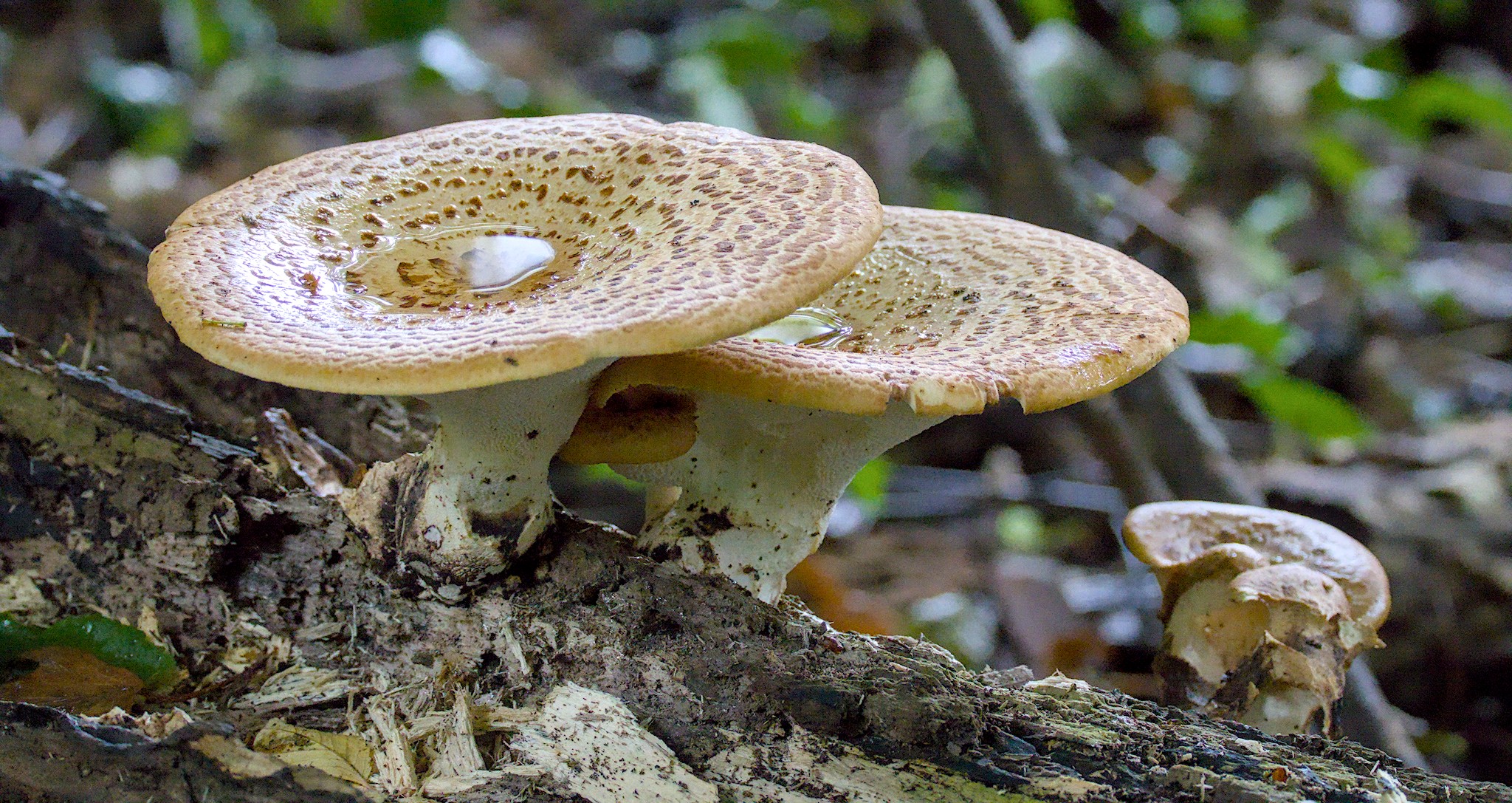
On 5th & 6th June 2026 I went down to Denso Marston Nature Reserve. The reason for the second visit was to confirm the ID of a fungus that I had found on a rotting log. The header image is a photo of it. I am pretty sure it is Dryad’s Saddle, Cerioporus squamosus. But as I was looking on-line there seemed to be a suggestion that it could be Cerioporus tuberaster.
As usual you can tap/touch/click on any image below to see it in better quality in the carousel gallery with an i for more information. And if you like what you see please click on one or more of the Share buttons at the bottom, or leave a comment.
Birds


On previous visits I had watched Moorhen building a nest at the far side of the pond and then seen a chick being fed tadpoles. On later visits there was no chick to be seen, and here they are having another go at building a nest.
The Wren also looks as though it is carrying nest material.
The Nuthatch, Blackcap, and Chiffchaff still have the gape visible at the corners of their beaks, showing that they are still being fed by their parents. The beak of the Nuthatch also looks shorter than mature one I have seen.
We finish the section with an obligatory Grey Heron.
Damselflies etc.
Early in my visits there were few Damselflies around but when the sun was out a few showed themselve on the wet reeds. As things dried there were lots of Banded Demoiselles flying over the grass of the wild flower.
A few varieties of bees were around, Bombus terrestris, Tree Bumblebee, Mating Red-tailed Bumblebees, Ashy Mining Bee, and Andrena scotica.
I always attempt to identify what I take photos of though often I can only go so far down the species tree. I am usually happy with that except with things like fungi where there has been convergent evolution and ones that look almost identical are totally unrelated. But there are a couple of surprises here. The mating Red-tailed Bumblebee, I would not have identified the male as Red-tailed if I had seen it on its own. And the Bumblebee Hoverfly, Volucella bombylans. It was very much like a Bumblebee. Initially I was comparing its colouring with Bumblebee ID charts, but its eyes and wings didn’t look right. After using on-line image ID I found it was a Hoverfly and so had only one pair of wings, Bees have two pairs.


Beetles and Things


I have seen a few Ladybirds mating, and the numbers of spots on each of the couple varied so perhaps Ladybirds can’t count. Perhaps it is like the Red-tailed Bumblebee where the male looks very different? Cue the internet. I haven’t investigated too much but the main factor in whether two will attempt to mate is pheromones. Both males and females, that can look identical, use pheromones. For several species this will match with spot count, colouring, and shapes made by the colouring. Mating might be attempted outside this but there are then other physical differences that mean reproduction will not happen. But then there are varieties of Harlequin Ladybirds where there is a variety of colour morphs for the same species and these can successfully mate but the colour does not relate to gender. Ladybird larvae were also on the prowl looking for Aphids.
An interesting fact that helped with the identification of the mating Reed Beetles, these being Grooved Leaf Beetles, Donacia semicuprea, is that they feed by gnawing away the top layer of leaf and you can see where they have done that.
I have also investigated why the male swollen-thighed beetle has such swollen thighs when the female doesn’t. Malcolm Burrows has a published paper, Do the enlarged hind legs of male thick-legged flower beetles contribute to take-off or mating?, in the Journal of Experimental Biology where the research shows that the strong thighs are used to cling to the female during mating.
Fungi and Flowers
The main reason for the second visit was to check on the Dryad’s Saddle fungus ID. Many of the photos and descriptions I read suggested that Dryad’s Saddle and Cerioporus tuberaster looked different but some photos of Cerioporus tuberaster looked very similar to the fungus I was looking at, but then I don’t think the IDs of some of them had been peer reviewed. But one difference that was mentioned was the smell, Dryad’s Saddle is supposed to smell strongly of cucumber. So I went down and cut a small part off the emerging fungus that had been identified as Dryad’s Saddle a couple of years ago – another help with ID being that it can appear in the same place year after year, and a piece off the rather good looking mushroom at the other end of the Reserve. To me both smelt the same and that was “not of much”. When I got home I cut a slice of cucumber and that smell was “not of much”. It might be logical, but it is not sensible, to say that when it smells “not of much” that you can say it smells strongly of something else that also smells “not of much”. However I don’t think it had a mild, pleasant, and classic mushroomy smell so perhaps I could discount Cerioporus tuberaster because of that.
One of the nice things about taking photos is that later on you can look over the photo and often spot other things, like the Aphid and Leafhopper on the Dryad’s Saddle.


Please click on the images to take you to better quality images in the carousel gallery where the i will let you see the title, and caption, and some photography info.
You can also leave comments or subscribe to the site – leave your email address and you will get notified when I publish something new.
The images are published under the Creative Commons, BY-NC-SA license. Feel free to share them, edit them, but please keep my name in the credits. And if I have got the ID of anything wrong please let me know, I don’t consider myself an expert but I have write something. It is often a best guess and it would take up too much room to say It could be this, or it could be… or perhaps.
Leave a Reply